


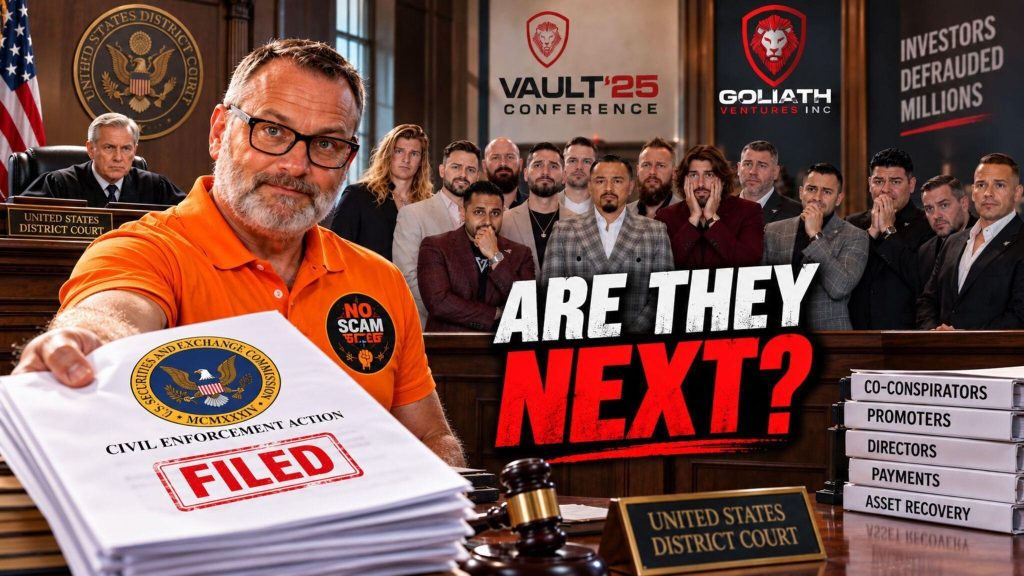
Christopher Delgado’s decision to plead guilty has added a new dimension to the federal investigation surrounding Goliath Ventures.
The former Goliath executive has acknowledged responsibility for federal offenses linked to the cryptocurrency investment business. Prosecutors have alleged that the conduct connected to the case resulted in losses of at least $250 million.
With Delgado’s criminal proceedings approaching the sentencing stage, attention is beginning to move beyond the former executive himself.
The question now facing investors, regulators and observers is whether authorities will continue concentrating on Delgado or examine other individuals who may have played roles within the Goliath operation.
At this point, there is no public evidence confirming that additional people will be criminally charged. However, separate actions by the Securities and Exchange Commission and the Commodity Futures Trading Commission indicate that the wider activities surrounding Goliath remain under examination.
Delgado’s Plea Marks a Major Turning Point
A guilty plea can significantly change the course of a federal investigation.
The Department of Justice has stated that Delgado pleaded guilty to conspiracy to commit wire fraud, wire fraud and money laundering. Prosecutors say the offenses resulted in losses of at least $250 million.
Authorities have also pursued assets connected to the criminal case.
That resolution establishes Delgado’s responsibility for the offenses to which he pleaded guilty. It does not establish that other executives, employees, associates or business partners were involved in unlawful activity.
That distinction could become increasingly important as investigators continue examining the company’s internal operations.
Because Delgado previously held a senior position at Goliath, he may possess information about the company’s structure, financial practices and relationships with investors.
Such information could be useful to investigators, although any allegations concerning other people would still need to be independently verified.
The Investigation May Now Look at the Wider Organization
A financial enterprise involving hundreds of millions of dollars rarely operates through a single person.
Different individuals may handle marketing, investor relations, accounting, technology, customer communications, banking or administrative functions.
However, performing a job within an organization does not automatically make someone part of a criminal scheme.
Investigators would need to establish what each person knew and whether that individual deliberately participated in conduct that violated the law.
Potential evidence could include internal emails, text messages, accounting records, contracts, bank statements, cryptocurrency transactions and testimony.
The important question is therefore not simply who worked at Goliath.
It is what those individuals knew and what they actually did.
The SEC’s Civil Case
The SEC has separately brought enforcement proceedings involving Goliath Ventures and Delgado.
In its allegations, the commission claims that Goliath obtained hundreds of millions of dollars from investors while promoting cryptocurrency-related investment opportunities and anticipated financial returns.
The SEC alleges that the use of investor money differed from the way those funds had been presented to customers.
The commission has also alleged that portions of the money were used for purposes unrelated to the representations made to investors, including payments involving earlier participants and personal expenditures.
These are allegations contained in civil litigation and should not be confused with criminal convictions.
Nevertheless, the SEC’s case provides a detailed outline of the conduct regulators say they are investigating.
Why the SEC’s Role Could Be Important
The SEC’s responsibilities extend beyond determining whether Delgado committed criminal offenses.
The commission can investigate whether companies and individuals violated federal securities laws.
That can involve examining investment promotions, statements to customers, financial disclosures and representations regarding how investor funds would be deployed.
Regulators could also examine who created marketing material, who communicated with investors and who approved particular claims.
If evidence eventually indicates that other individuals knowingly participated in securities violations, those people could potentially become subjects of regulatory action.
That remains a possibility rather than an established outcome.
The CFTC Is Investigating Too
The regulatory picture does not end with the SEC.
The Commodity Futures Trading Commission has also filed a civil action involving Goliath and Delgado.
The CFTC alleges that approximately 1,600 customers contributed at least $397 million and that investors received misleading information regarding the nature and expected performance of their investments.
The agency is pursuing its own forms of legal relief.
The presence of both the SEC and CFTC is notable because the allegations are being considered under different areas of federal financial regulation.
Their separate proceedings could also produce additional documents and information relevant to understanding Goliath’s activities.
Why the Financial Figures Matter
The various government proceedings contain different estimates concerning the amount of money involved.
According to the DOJ, Delgado admitted responsibility for at least $250 million in losses.
The SEC has alleged that Goliath raised at least $425 million from more than 1,300 investors.
The CFTC has cited approximately $397 million in contributions from roughly 1,600 customers.
These figures should not be combined as though they describe one identical pool of money. The agencies are addressing different proceedings, customers and legal allegations.
Nevertheless, the amounts demonstrate the enormous scale of the activity being examined.
The larger the financial operation, the greater the potential volume of records available to investigators.
The Financial Trail Could Provide Answers
Following the movement of money may be one of the most important parts of the investigation.
Bank records can reveal transfers between accounts.
Corporate ledgers can show how transactions were categorized.
Cryptocurrency records can demonstrate the movement of digital assets.
Exchange records can potentially connect wallet activity to real-world identities.
Communications can provide context about why payments were made and who authorized them.
None of these records necessarily establishes criminal conduct on its own.
But when multiple sources point toward the same transaction or decision, investigators may be able to develop a clearer understanding of what happened.
Cryptocurrency Adds Another Layer
Digital assets create particular challenges for investigators.
Blockchain transactions are generally recorded publicly, but a wallet address does not automatically reveal the identity of its owner.
Authorities may therefore need information from cryptocurrency exchanges, banks, businesses and communications to determine who controlled particular addresses.
Once those links are established, investigators can trace the movement of assets through multiple transactions.
That could become significant if authorities attempt to determine whether other individuals knowingly moved, received or benefited from funds allegedly connected to the Goliath operation.
What Delgado May Know
Delgado’s former leadership position could make his knowledge of Goliath particularly relevant.
He may know how the company was organized and which individuals were responsible for various areas of the business.
He may also have knowledge of investor communications, financial arrangements and decisions involving company funds.
But prosecutors and regulators would still need to test such information against other evidence.
A defendant’s statements can provide investigative leads, but significant allegations concerning another person generally require corroboration.
That is especially important in a case where public speculation could easily move faster than the evidence.
An Employee Is Not Automatically a Co-Conspirator
The distinction between association and participation is critical.
Someone could have worked for Goliath without knowing about alleged misconduct.
A professional adviser could have provided legitimate services without understanding the company’s alleged financial practices.
A person appearing in promotional material may not have known whether the underlying investment claims were accurate.
Likewise, receiving compensation from a company does not automatically demonstrate participation in fraud.
For regulators or prosecutors to pursue an individual, evidence would need to establish that person’s own involvement and, where legally required, knowledge or intent.
What Regulators Could Examine Next
If scrutiny expands, investigators could review numerous aspects of Goliath’s business.
Investor presentations could be compared with actual financial activity.
Marketing campaigns could be examined to determine what claims were made to potential customers.
Internal communications could reveal who prepared or approved particular statements.
Accounting records could help establish where investor funds went.
Compensation structures could show whether individuals were rewarded for attracting additional investors.
Investigators could also examine whether particular executives or employees had responsibility for financial decisions.
The objective would be to determine whether laws were violated and whether additional individuals can be linked to those violations through evidence.
Asset Recovery Is Another Major Issue
The government has also taken steps to pursue assets associated with Delgado’s offenses.
Federal authorities say Delgado has agreed to forfeit significant property and luxury assets connected to the case.
Asset recovery can become especially important when alleged losses reach hundreds of millions of dollars.
However, recovering property does not necessarily mean investors will immediately receive equivalent amounts of money.
Assets can face competing claims and legal restrictions. Some may need to be sold, while other funds may already have been transferred or spent.
The eventual amount recovered by victims could therefore depend on the outcome of several legal processes.
Bankruptcy Could Shed More Light
Goliath’s bankruptcy proceedings represent another potential source of information.
Bankruptcy requires a detailed accounting of assets, debts, claims and other financial obligations.
Those records could help determine what remains available and how creditors may ultimately be treated.
The process may also provide investigators with additional documentation concerning the company’s financial condition.
For investors, bankruptcy could become an important part of the recovery process.
For regulators, it may offer another window into the company’s finances.
What Investors Want Answered
The people affected by the alleged scheme are likely focused on practical questions.
Where did their money go?
How much can eventually be recovered?
Who made the investment promises?
Were those promises accurate?
Did other people know about the alleged misconduct?
And could additional individuals eventually be held legally responsible?
There may not be one proceeding that answers all of those questions.
The criminal case involving Delgado addresses criminal responsibility.
The SEC and CFTC cases examine regulatory and civil allegations.
Bankruptcy addresses the company’s financial obligations.
Asset-recovery proceedings focus on property and funds that may be available for recovery.
Together, these processes could gradually provide a fuller picture.
Social Media Should Not Replace Evidence
Cases involving cryptocurrency and large financial losses often generate intense online speculation.
Individuals can quickly become subjects of accusations simply because they were photographed with a defendant, worked at the same company or appeared in old promotional material.
Those connections are not proof of wrongdoing.
There is a significant legal difference between being mentioned in a document, being professionally connected to a defendant, being accused in a civil complaint and being criminally charged.
That distinction should remain clear throughout the investigation.
Could More Individuals Eventually Face Action?
There is a possibility that authorities could broaden their focus.
For example, communications might reveal that another individual knowingly helped create misleading statements.
Financial records could potentially show that someone knowingly participated in moving or concealing improperly obtained funds.
Evidence might also establish that certain people benefited from the alleged conduct while understanding its nature.
But investigators could reach the opposite conclusion.
Records may show that some employees, contractors or associates had no knowledge of the alleged misconduct.
That is why the evidence, rather than professional relationships or public speculation, will ultimately determine the direction of the investigation.
A Broader Lesson for Crypto Investors
The Goliath case also highlights the importance of due diligence in cryptocurrency investments.
Investment opportunities involving blockchain technology can sound highly technical and sophisticated.
That does not necessarily make them safe or legitimate.
Investors should understand how returns are supposedly generated, where their funds are held and whether claims about performance can be independently verified.
They should also examine the underlying business rather than relying solely on technical terminology or promotional material.
Promises of unusually high or consistent returns deserve particular scrutiny.
What Happens From Here?
Several developments could shape the next stage of the Goliath case.
Delgado’s criminal matter will proceed toward sentencing.
The SEC’s civil litigation remains ongoing.
The CFTC’s action will continue separately.
Authorities can continue pursuing assets connected to the alleged offenses.
Meanwhile, bankruptcy proceedings may provide further information about Goliath’s remaining assets and liabilities.
Investigators could also continue examining financial records, cryptocurrency transactions and communications involving people connected with the organization.
Whether those efforts lead to additional charges or regulatory actions remains uncertain.
The SEC May Be Looking at More Than Delgado
It would be premature to say that the SEC has decided to pursue Goliath’s alleged co-conspirators.
No public evidence currently establishes that additional individuals will necessarily face charges.
What can be said is that the regulatory scrutiny surrounding Goliath extends beyond Delgado’s guilty plea.
The SEC’s civil case, the CFTC proceeding, the federal criminal prosecution and the bankruptcy process each provide different avenues for examining what happened.
If evidence identifies further violations or participants, the investigation could expand.
If the evidence does not support additional action, the legal focus may remain on the people already named.
The Larger Goliath Picture Is Still Emerging
Delgado’s guilty plea answers an important question about his own conduct.
It does not necessarily explain the full operation of Goliath.
Investigators still have to determine how funds moved, how investors were approached, who made important decisions and what different people knew at the time.
The answers may emerge gradually through criminal proceedings, regulatory litigation, financial records, blockchain evidence and bankruptcy documents.
For investors, the desired outcome is straightforward: accountability and the greatest possible recovery of lost funds.
For investigators, the principle is equally straightforward:
Follow the evidence.
A connection to Delgado or Goliath alone does not establish guilt.
If additional individuals knowingly participated in unlawful conduct, evidence could eventually bring them under greater scrutiny.
If the evidence shows otherwise, those individuals should not be treated as responsible simply because they were associated with the company.
For now, the Goliath investigation remains an evolving story. Delgado’s guilty plea may have closed one chapter, but the broader questions surrounding the company’s operations, financial flows and potential responsibility elsewhere remain unresolved.

