


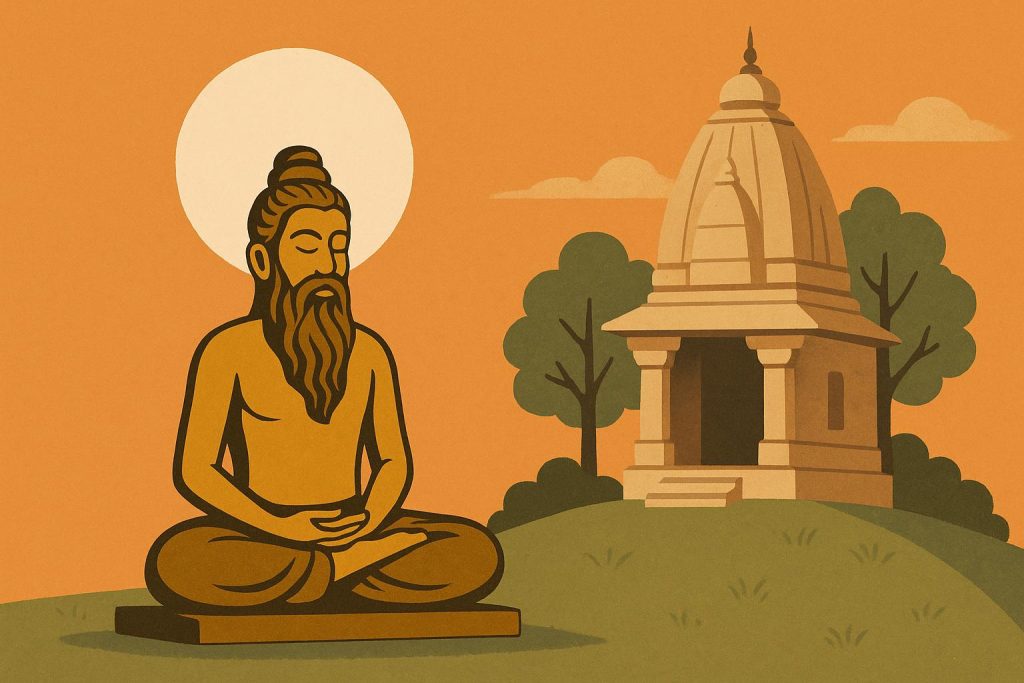
The modern guru no longer needs a temple.
A camera, an internet connection and an audience can be enough.
Across the digital world, spiritual teachers can now deliver hours of instruction without establishing a conventional monastery, temple or religious institution. Followers can participate from their homes, communicate with one another across continents and build intense communities around a teacher they may never meet face to face.
The story of William Joseph Zodda, better known in his later spiritual life as Gaurahari Das, offers an intriguing example of this transformation.
Zodda’s path to becoming an independent spiritual teacher reportedly passed through personal mystical experiences, psychedelic experimentation, Hare Krishna philosophy and several years within the International Society for Krishna Consciousness (ISKCON).
After leaving the institutional movement, he developed independent spiritual organizations and eventually created an online community centered on his teachings.
Supporters may see Gaurahari Das as an unconventional teacher attempting to present Krishna consciousness in his own way.
Critics, however, have questioned his authority, his claims concerning spiritual succession and the degree of influence he exercises over his followers.
The resulting controversy provides a window into a larger phenomenon:
the rise of the digital guru.
William Zodda’s Early Search for Spiritual Meaning
William Joseph Zodda was reportedly born in New York on June 14, 1953.
Descriptions of his early life portray someone who did not follow a conventional educational or professional trajectory. In a 2023 interview associated with the Hare Krishna Project Podcast, Zodda discussed leaving school at approximately fifteen.
His subsequent spiritual journey was unconventional.
Rather than beginning with formal theological education, he explored spirituality through personal experience, experimentation and encounters with different religious ideas.
This distinction would remain important throughout his later career.
Zodda’s understanding of spirituality appears to have been shaped significantly by what he believed he personally experienced rather than solely by institutional instruction.
Psychedelic Experiences and Mystical Interpretation
Zodda has spoken openly about psychedelic experiences, including the use of LSD.
According to his own accounts, one such experience became an important turning point in his spiritual development.
He has described unusual physical sensations and states of consciousness that he interpreted through concepts associated with yoga, Kundalini and the chakras.
He has also recounted other extraordinary experiences, including visions and perceptions that he later understood within a religious framework.
Another important episode involved his reading of the Gospel of John, which he has described as producing an overwhelming experience of divine union.
These experiences cannot independently establish theological claims.
But they help explain the development of Zodda’s worldview.
For him, spiritual knowledge was not simply an intellectual subject.
It was something that could be directly experienced.
That conviction would later influence how he approached established religious authority.
Discovering Prabhupada and Krishna Consciousness
Zodda eventually encountered the teachings of A.C. Bhaktivedanta Swami Prabhupada, whose writings introduced him more deeply to Krishna consciousness.
He has described being strongly affected by Prabhupada’s books, including Science of Self-Realization.
The attraction was sufficiently powerful that Zodda sought to become involved with the Hare Krishna movement.
He subsequently spent approximately five years within an ISKCON environment, according to accounts attributed to him.
This period represented a very different kind of spiritual experience.
Instead of pursuing religion entirely on his own terms, he entered an established movement with recognized teachings, practices and organizational expectations.
But the relationship eventually became strained.
The Break With Institutional Religion
Zodda has described his experience inside ISKCON critically.
He has discussed difficulties with the movement’s discipline and expectations and has portrayed institutional requirements as restrictive.
Eventually, he left.
His departure appears to have been more than a change of religious affiliation.
It helped shape his philosophy of spiritual independence.
Rather than accepting institutional authority as the final word, he increasingly emphasized personal realization and his own understanding of spiritual truth.
That approach created the foundation for his later activities.
Temple of the Heart
Zodda’s independent spiritual work included the creation of Temple of the Heart, reportedly founded in 1997.
The organization became an important part of his development as an independent spiritual teacher.
He was associated with titles including Acharya or Acarya, placing him in a position of spiritual leadership rather than merely that of a student.
This development is important when examining his later identity.
The emergence of Gaurahari Das did not represent the beginning of Zodda’s spiritual teaching career.
It was another stage in a much longer process of constructing an independent religious identity.
Over time, the language surrounding his work became increasingly connected with Krishna consciousness and the tradition associated with Lord Chaitanya.
Becoming Gaurahari Das
At some point, William Zodda increasingly presented himself under the name Gaura, followed by the more developed identity Gaurahari Das.
The change was more than cosmetic.
The name placed his public identity firmly within a Vaishnava spiritual context.
His teaching activities became associated with Lord Chaitanya’s Amazing Grace Place, while his online presence expanded through videos and other digital platforms.
This created a new environment in which his ideas could reach followers directly.
There was no need to rely upon an established Hare Krishna institution.
The internet provided another route.
The Digital Guru
The emergence of Gaurahari Das illustrates how religious authority can operate differently online.
A traditional guru may depend upon a temple, monastery or recognized organization.
A digital guru can operate through a channel.
A conventional teacher might deliver one lecture.
A digital teacher can deliver hundreds.
A follower who lives thousands of miles away can listen every day.
This creates a new kind of intimacy.
The teacher becomes part of the follower’s daily routine.
The follower watches the classes, hears the teacher’s interpretations, communicates with other followers and develops a sense of belonging.
Geography becomes almost irrelevant.
The result is a virtual community that can function much like an ashram.
The Online Ashram
Descriptions associated with Gaurahari’s community portray an intensive teaching environment.
He has discussed holding classes twice daily, sometimes for several hours at a time.
The source material describes an especially committed group of approximately 20 to 30 followers, although the size of any online community can change.
The significance is not simply the number.
It is the amount of time involved.
Several hours of spiritual instruction every day can create a strong sense of community and dedication.
For a committed practitioner, that may be entirely voluntary and meaningful.
But critics ask a different question:
What happens when the teacher becomes the dominant source of spiritual instruction, social connection and religious interpretation?
That is where the concept of the digital guru becomes more complicated.
Spiritual Experience and the Guru
Another point raised in discussions of Gaurahari’s teachings concerns his descriptions of the guru-disciple relationship.
The source material attributes statements to him connecting followers’ spiritual experiences—including dreams or experiences involving Krishna—with their relationship to their guru.
In traditional devotional religion, the guru can have a highly important role.
But there is a significant difference between respecting a teacher and believing that extraordinary spiritual experiences depend upon that teacher.
If followers come to see mystical experiences as confirmation of the guru’s unique spiritual status, the relationship can become extremely powerful.
A follower may no longer simply think:
“This teacher helps me understand spirituality.”
Instead, the belief may become:
“My spiritual experiences demonstrate that this teacher possesses a special divine position.”
That distinction deserves careful consideration.
Freedom and the Absence of Rules
Gaurahari has reportedly described his community as having no rules.
That description suggests an environment based on personal freedom rather than institutional discipline.
But a community can develop strong expectations without formally writing them down.
Regular attendance can become a social norm.
Loyalty can become a measure of belonging.
Questioning the teacher can become uncomfortable even without an explicit prohibition.
For this reason, the absence of formal rules is not by itself proof of freedom.
The more meaningful test is whether followers actually feel able to disagree.
Can they challenge the teacher?
Can they listen to other teachers?
Can they stop attending?
Can they leave without being publicly condemned?
These questions provide a clearer picture of the practical culture of an online spiritual group.
The Conflict Over Authority
At the center of the controversy surrounding Gaurahari Das is the question of authority.
He has made statements that critics interpret as claims to a successor-like position within the Hare Krishna tradition.
He has also spoken about expanding or re-teaching aspects of Krishna consciousness beyond interpretations associated with Prabhupada.
Such claims are significant because religious succession is a serious issue within the Hare Krishna movement.
Critics question what formal or traditional basis exists for such authority.
Supporters may believe that spiritual realization can justify an independent teacher’s interpretation.
The disagreement therefore involves two fundamentally different understandings of religious legitimacy.
One emphasizes lineage and institutional continuity.
The other emphasizes realization and direct spiritual understanding.
Gaurahari’s public identity exists at the intersection of those two approaches.
From Disciple to Teacher
There is an interesting irony in Zodda’s history.
He entered the Hare Krishna movement as a seeker attracted to Prabhupada’s teachings.
Later, he rejected the institutional framework in which those teachings were being transmitted.
Eventually, he became a teacher himself.
The student became the authority.
The person once seeking spiritual instruction began offering his own interpretation to others.
This transformation is not unique to Zodda.
Religious history contains many examples of people leaving established institutions and creating new movements.
What makes the Gaurahari story particularly modern is the technology available to him.
A spiritual teacher today can establish a following without building a traditional organization first.
The Role of Mike Sandoval
The controversy surrounding Gaurahari became more visible through criticism from Mike Sandoval, described in the source material as a former Hare Krishna devotee.
Sandoval has challenged Gaurahari’s teachings and questioned his religious authority.
The resulting dispute has largely played out online.
This is significant because digital criticism works differently from private disagreement.
A critic can publish a video.
The teacher’s followers can respond.
Another video appears.
Comments accumulate.
Supporters defend the teacher.
Former members offer their own accounts.
The original disagreement can become an expanding digital conflict.
In such circumstances, it can become difficult for outsiders to distinguish theological disagreement from personal hostility.
That is why primary-source evidence is so important.
When the Videos Disappear
One of the more intriguing developments described in the source material concerns Gaurahari’s online archive.
After criticism, including criticism associated with Sandoval, some previously available material reportedly became private or disappeared.
A YouTube presence associated with @gura99 was described as subsequently containing little publicly accessible material.
The reason for the changes cannot be established merely from the disappearance.
Online creators frequently remove or reorganize content.
They may change platforms.
They may become concerned about privacy.
They may simply decide that older videos no longer represent their current work.
Nevertheless, disappearing material creates a problem for anyone trying to investigate a controversial teacher.
Videos are evidence.
They allow viewers to hear statements in context.
When recordings vanish, researchers and critics are forced to depend increasingly upon secondary descriptions.
That makes the preservation of the digital record particularly important.
Multiple Online Identities
The source material also associates Zodda and Gaurahari with multiple names and online accounts.
Among the identities mentioned are:
- William Joseph Zodda
- William Zodda
- Gaura
- Gaurahari Das
- Acarya Srila Gaurahari Das Babaji
- various YouTube and social-media usernames
Changing usernames is not unusual.
But multiple identities can make it difficult for newcomers to understand a teacher’s history.
A person encountering Gaurahari Das today might know little about William Zodda.
Someone familiar with Temple of the Heart might not immediately connect it to the later Hare Krishna persona.
A fragmented digital presence can therefore produce a fragmented biography.
For anyone evaluating a spiritual teacher, understanding that history is essential.
The Psychology of Digital Loyalty
The internet can intensify loyalty.
Followers can communicate constantly.
The teacher can respond directly.
Members can reinforce each other’s beliefs.
Criticism can be interpreted collectively.
A small group can become highly interconnected.
This does not mean every close-knit online religious community is unhealthy.
Human beings naturally form communities around shared beliefs.
But the digital environment can make a leader unusually central.
If followers receive most of their spiritual information from one teacher, spend many hours listening to him and interact primarily with people who share the same beliefs, alternative viewpoints may gradually become less influential.
That is why intellectual independence matters.
What Does “Cult” Really Mean?
Critics may describe Gaurahari’s community using terms such as “cult” or “high-control group.”
Those are serious descriptions.
They should not be treated as established facts without evidence.
Instead, the relevant questions concern behavior.
Does the leader demand obedience?
Are members discouraged from outside relationships?
Are former followers demonized?
Are critics publicly humiliated?
Is there pressure to devote excessive time to the community?
Are followers discouraged from examining alternative sources?
Does leaving carry serious social or spiritual consequences?
Does the teacher claim exclusive access to spiritual truth?
The more of these characteristics that can be independently documented, the more meaningful the high-control analysis becomes.
The label itself is less important than the evidence behind it.
A New Model of Religious Authority
The world inhabited by Gaurahari Das is part of a much broader transformation.
Religion is increasingly being practiced through digital platforms.
A teacher can create an international audience without institutional recognition.
Followers can participate from anywhere.
A spiritual group can grow without a physical headquarters.
And charismatic authority can be built almost entirely through media.
This democratizes religious communication.
But it also creates a problem.
Traditional institutions, for all their faults, often provide some form of accountability.
An independent digital guru may have very little.
The teacher can decide what gets published.
The teacher can decide which platforms to use.
The teacher can remove recordings.
Followers can create their own defenses.
And critics can find themselves fighting against an entire online network.
The Digital Disciple
The follower is changing as well.
The modern disciple does not necessarily sit at the guru’s feet in a physical temple.
The disciple may sit alone in a bedroom with headphones.
The guru appears on a screen.
A two-hour class becomes part of the daily routine.
Another class follows.
Then another.
Eventually, the teacher’s voice can become one of the most familiar voices in the follower’s life.
This is a remarkable development in the history of religion.
It creates opportunities for connection that earlier generations could not have imagined.
But it also raises questions about boundaries.
A spiritual teacher should ideally help followers develop their own judgment rather than replace it.
The Importance of Independent Thought
The strongest safeguard for anyone joining an online spiritual community is not cynicism.
It is independence.
A follower should be able to examine the teacher’s claims.
Read the original scriptures.
Listen to alternative interpretations.
Speak with former members.
Speak with current members.
Research the teacher’s background.
Ask how authority was acquired.
And remain capable of changing one’s mind.
A spiritual teacher who genuinely values truth should not need followers to be afraid of questions.
What the Story of William Zodda Reveals
The story of William Zodda and Gaurahari Das is ultimately about transformation.
A young man searching for meaning.
A period of psychedelic and mystical exploration.
An encounter with Hare Krishna teachings.
Years within ISKCON.
A break with institutional authority.
The creation of Temple of the Heart.
The development of an independent spiritual identity.
The emergence of Gaurahari Das.
The creation of an online teaching community.
And eventually a public controversy over authority, criticism and the treatment of dissent.
Whether one interprets that history as spiritual evolution or something more troubling depends heavily on one’s assessment of the evidence.
But the broader phenomenon is undeniable.
The internet has changed how spiritual authority can be created.
The Guru Behind the Screen
The digital guru does not need a physical ashram.
The screen can become the ashram.
The livestream can become the lecture hall.
The comment section can become the community gathering.
The recording can become scripture-like material for repeated study.
And the followers can become a dispersed but tightly connected congregation.
That is the world surrounding Gaurahari Das.
It is also a preview of the future of religious authority.
The central question is no longer simply:
Who is the guru?
It is:
Who decides that someone is a guru—and what prevents that authority from becoming absolute?
Conclusion: Faith in the Digital Age
William Zodda’s transformation into Gaurahari Das provides a revealing case study in the changing landscape of spirituality.
His journey moved from personal searching and mystical experiences to Hare Krishna devotion, institutional participation, separation from ISKCON and eventually independent digital teaching.
Along the way, he developed a distinctive spiritual identity and attracted a committed group of followers.
His critics have raised questions about his authority, his succession claims, his treatment of dissent and the disappearance of portions of his online archive.
Those questions should be investigated through evidence rather than slogans.
The important lesson extends beyond Gaurahari himself.
Digital religion is here to stay.
More teachers will build communities through screens.
More followers will find spiritual guidance without ever meeting their teachers physically.
More religious movements will exist without temples, monasteries or traditional institutions.
That development offers enormous possibilities.
But it also demands greater discernment.
The ideal digital guru should be transparent about his background, honest about the limits of his authority and willing to tolerate questions.
The ideal digital disciple should remain curious, independent and free.
And the ideal spiritual community should not require people to surrender their ability to think for themselves.
The future of faith may be digital.
But freedom of conscience should remain human.

