


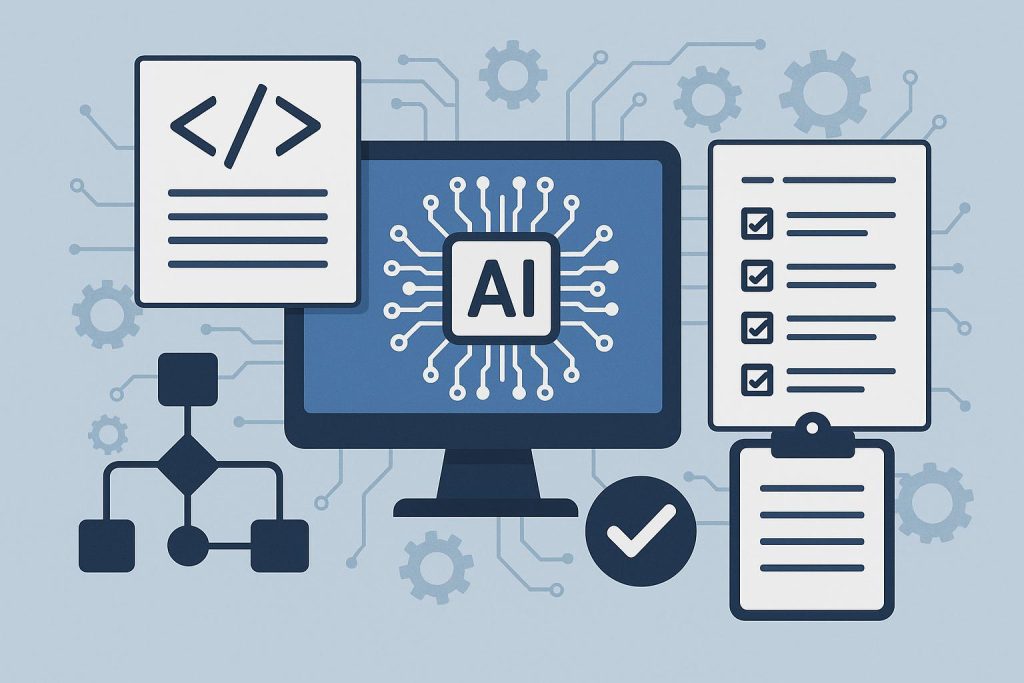
Modern software development moves faster than ever, but quality assurance teams are often expected to keep pace without additional resources. One of the most time-consuming parts of the QA lifecycle remains the process of analyzing business requirements and converting them into detailed test cases.
Traditionally, QA engineers spend hours reviewing requirement documents, identifying edge cases, mapping user journeys, and documenting test scenarios. While this process is essential for ensuring software quality, it can create bottlenecks when requirements change frequently or when projects involve extensive documentation.
Artificial intelligence is changing this reality. Today, AI-powered tools can analyze requirement documents, identify critical workflows, and generate comprehensive test scenarios in a fraction of the time required by manual processes. As a result, QA teams can focus more on validation, exploratory testing, and improving product quality rather than spending countless hours on documentation.
The Challenge of Translating Requirements into Test Cases
Requirements gathering and test design have always been closely connected. However, several challenges often emerge during this transition:
- Large requirement documents can contain hundreds of pages.
- Critical acceptance criteria may be scattered across multiple sources.
- Business logic can be complex and difficult to interpret consistently.
- Human reviewers may overlook edge cases or exception paths.
- Frequent requirement changes require continuous test case updates.
These challenges become even more significant in Agile environments where requirements evolve rapidly, and testing cycles are compressed.
The ability to quickly transform requirements into actionable test scenarios can dramatically improve both QA efficiency and software quality.
How AI Analyzes Business Requirements
Modern large language models (LLMs) have demonstrated remarkable capabilities in understanding natural language and extracting structured information from complex documents.
Instead of manually reviewing every requirement, QA teams can leverage AI to:
- Identify functional requirements automatically.
- Extract acceptance criteria.
- Detect business rules and dependencies.
- Highlight missing or ambiguous requirements.
- Suggest positive, negative, and edge-case scenarios.
- Generate initial test case drafts.
This process helps reduce the time spent on repetitive analysis while ensuring broader coverage across the application.
For organizations dealing with extensive product specifications, AI serves as an intelligent assistant that accelerates the path from requirements to testing.
AI-Assisted Test Case Generation in Practice
One of the most valuable applications of AI in quality assurance is AI-assisted test case generation.
By analyzing requirement documents, user stories, feature descriptions, and acceptance criteria, AI can generate:
Functional Test Cases
AI can identify expected user behaviors and create test scenarios that validate core functionality.
For example, given a user story describing account registration, AI may generate tests covering:
- Successful registration
- Invalid email formats
- Duplicate account prevention
- Password policy validation
- Verification email workflows
Negative Test Scenarios
AI excels at systematically exploring failure conditions that human testers may overlook.
Examples include:
- Missing mandatory fields
- Invalid input formats
- Unauthorized access attempts
- Boundary value violations
Edge Cases
Many defects emerge from unusual combinations of inputs or unexpected user behavior.
AI can help identify:
- Maximum character limits
- Concurrent user actions
- Unusual workflow sequences
- Rare business rule combinations
The result is often a broader and more comprehensive test suite generated significantly faster than traditional manual methods.
Using Claude for Requirement Analysis and Test Design
One particularly interesting example is the growing use of Claude in QA workflows.
Claude can process large requirement documents and help QA teams identify critical functionality, generate test ideas, summarize specifications, and uncover potential gaps in requirements before testing even begins.
Because it can handle extensive context windows, Claude is especially useful for projects involving lengthy specifications, regulatory requirements, or complex enterprise systems.
For teams interested in exploring practical examples, limitations, and real-world applications, this guide on Claude use cases in software testing provides a detailed overview of how QA engineers are leveraging Claude to improve productivity and test coverage.
While Claude can significantly accelerate analysis and planning, human review remains essential to validate generated scenarios and ensure alignment with business objectives.
Beyond QA: Understanding AI’s Broader Impact
The influence of artificial intelligence extends far beyond software testing.
Organizations are increasingly using AI to optimize customer support, marketing, content creation, operations, analytics, and decision-making processes. As AI adoption accelerates, professionals across industries are seeking ways to understand how these technologies are reshaping business workflows.
For readers interested in exploring AI developments beyond testing and quality assurance, NeuroBits AI provides insights into emerging trends, practical applications, and the broader impact of artificial intelligence across multiple industries and business functions.
Combining AI with Test Automation
The greatest benefits emerge when AI-powered requirement analysis is combined with modern test automation platforms.
Instead of stopping at test case generation, organizations can extend the workflow further:
- Analyze requirements using AI.
- Generate comprehensive test scenarios.
- Convert scenarios into automated tests.
- Execute tests continuously within CI/CD pipelines.
- Use AI to identify failures and suggest root causes.
This creates a highly efficient QA process where requirements, test design, automation, and execution become tightly integrated.
As AI models continue to improve, the gap between business requirements and executable tests will continue to shrink.
Best Practices for AI-Driven Test Design
Although AI offers substantial benefits, teams should follow several best practices:
Treat AI as an Assistant
AI-generated test cases should be reviewed by experienced QA professionals. Human expertise remains critical for validating business context and risk assessment.
Verify Requirement Accuracy
If requirements are incomplete or ambiguous, AI-generated tests may inherit those weaknesses. Requirement quality still matters.
Focus on Coverage
Use AI to broaden coverage rather than simply speed up documentation.
Continuously Refine Prompts
The quality of generated test cases often improves significantly when QA teams develop structured prompting techniques and reusable templates.
Integrate with Existing QA Processes
AI works best when incorporated into established testing workflows rather than treated as a standalone solution.
The Future of Requirements-Based Testing
The traditional process of manually converting requirements into test cases is rapidly evolving. AI can now analyze large volumes of business documentation, identify critical workflows, and generate actionable test scenarios within minutes.
As tools continue to improve, QA teams will spend less time creating test documentation and more time focusing on strategic quality initiatives, exploratory testing, risk assessment, and customer experience.
Whether through AI-powered requirement analysis, intelligent test generation, or advanced automation platforms, the future of QA is increasingly driven by technologies that help teams deliver higher-quality software faster and with greater confidence.

